
You’re staring at a blank screen and a blinking cursor, wondering how to draft an email your audience will want to open, read, and interact with. There’s no need to stress yourself over crafting the perfect email from scratch when, like most marketers, you probably just need to see real email copy examples you can start using now.
Research shows that email delivers a high return on investment at an average of $36 per every $1 spent, with 44% of marketers naming it their most effective channel. But if you don’t know how to put together campaigns that convert, you’ll only be wasting time and effort creating copy that isn’t helping your organization achieve its goals.
Here are examples of eight successful email types and what makes each one convert.
What do high-converting emails look like in 2026?
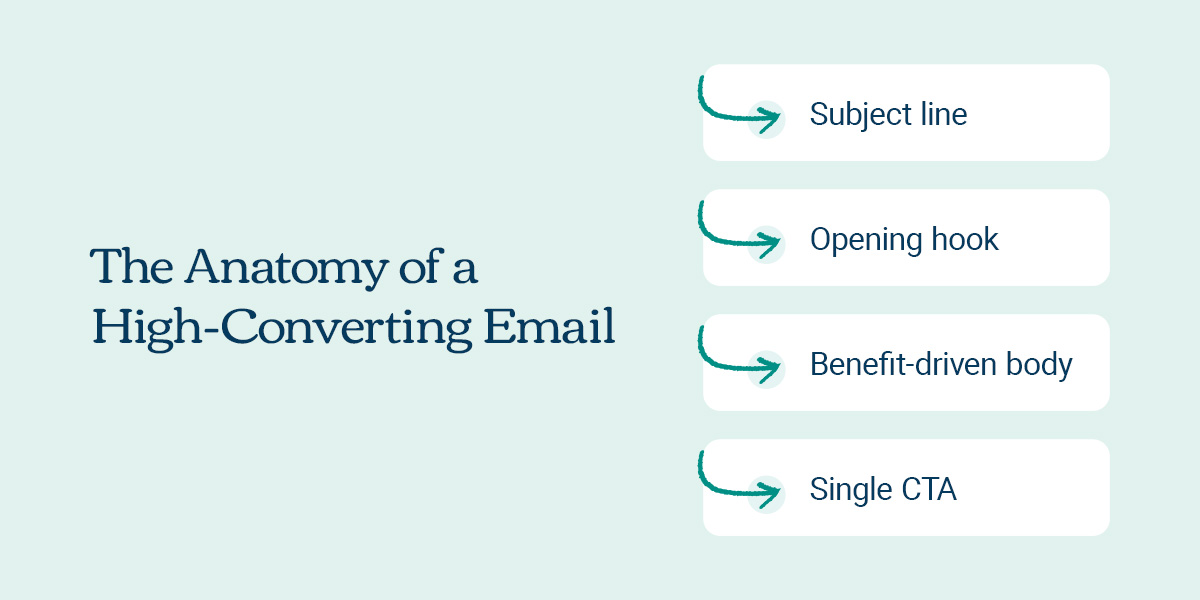
Before we introduce you to our email copywriting best practices, here are four elements that separate successful campaigns from those that get ignored.
- Subject line: Most recipients make their open-or-delete decision in a split second based on the subject line alone. Personalized subject lines tend to perform better, so consider tailoring yours when possible.
- Opening hook: Let the first line do the heavy lifting by addressing a genuine feeling or problem. Remember, your subject line should convince people to open, while the first sentence keeps them reading.
- Benefit-driven body: Since most readers tend to skim, lead with what’s in it for them rather than a lengthy list of features or unnecessary background details. When you focus on outcomes, email open rates improve because the value is evident from the start.
- Single call to action: Giving people too many choices will overwhelm them and can create decision paralysis. Pick one simple thing you want your readers to do and build the email around that.
8 email copywriting examples that work
Here are eight email types you can integrate into your marketing strategy, with concrete examples of why they succeed.
1. Welcome email
The most-opened emails set expectations, deliver on the promise of the sign-up, and start the relationship with your customer or client on a positive note.
- Example: “Thanks for subscribing! Here’s what happens next—you’ll get tips on [topic] every Tuesday, plus early access to our monthly resources. The first one lands tomorrow morning.”
- Why it works: It confirms the action, sets expectations and a timetable, and gives the subscriber something to look forward to. A well-built welcome series can set the tone for every email that follows.
2. Promotional email
High-converting promo emails are a marketing workhorse. B2B email copywriting for promotions focuses on value and urgency, while B2C email copywriting often emphasizes emotion and immediacy, leading with an offer and a single clear path to action makes sense for both groups.
- Example: “Register for our spring open house by Friday and get priority access to campus tours. Reserve your spot now.”
- Why it works: The offer is specific, the timeline is urgent, and the CTA is unmistakable.
3. Reengagement email
When your subscribers go quiet, your goal should be to remind them why they signed up and reignite their curiosity, not try and sell to an already uninterested party.
- Example: “Still interested? We haven’t seen you in a while, and we wanted to check in. Please confirm you’d like to keep hearing from us. If not, no hard feelings—we’ll unsubscribe you.”
- Why it works: It’s honest, low-pressure, and respectful. Retaining a lapsed subscriber costs less than bringing a new one on board, so this email type is worth the effort.
4. Newsletter
Not every message needs a persuasive CTA. Newsletter content helps establish the foundational relationship that helps every other email you send perform better.
- Example: “This month we’re looking at three quick wins for better subject lines, a case study on event email performance from [relevant vertical], and one tool we love right now.”
- Why it works: This approach delivers informational value without asking for anything in return. Over 50% of consumers have made a purchase directly because of a marketing email they received, not just sales. A well-crafted email newsletter keeps your brand top of mind without feeling like a sales pitch.
5. Registration abandonment email
When someone starts filling out an event registration or webinar sign-up form but doesn’t complete it, try this automated follow-up to bring them back.
- Example: “Looks like you started signing up for our webinar on [topic]—want to finish? Your spot is still available. Complete your registration now.”
- Why it works: It acknowledges what happened without making assumptions and removes friction by linking directly back to the form. An automated email workflow can handle this without manual effort.
6. Milestone email
Emails that celebrate birthdays, anniversaries, and subscriber milestones have inherent sentimental value because they make people feel seen and valued.
- Example: “Happy anniversary! It’s been a year since you joined us. As a thank you, you now have early access to our new member resources.”
- Why it works: It’s timely and unexpected. People are more likely to notice and open emails with personalized subject lines, and milestone emails are among the easiest places to add authenticity.
7. Event invitation
Lead with the benefits instead of the event details. When reaching out to new contacts, a copywriting cold email template for event invitations should emphasize immediate value rather than lengthy context.
- Example: “Join us for a live Q&A on improving email engagement—get your trickiest questions answered in real time. Register now for our free webinar on May 15.”
- Why it works: It leads with the benefit, then delivers the logistics, demonstrating the value before the ask.
8. Product launch
Deliver timely updates and move subscribers toward a potential decision by letting them know your product is consistently being improved for their benefit.
- Example: “It’s here! Our new [product] is now available—designed to help you [specific outcome]. Be one of the first to try it.”
- Why it works: Brief sentences create a compelling momentum. Keep the copy focused on what the product does for the reader.
What these examples have in common
These eight emails look different on the surface, but the same core principles drive their effectiveness.
- Reader-first language: The email body should address what your subscribers care about, not what your brand wants to promote. Writing email copy that connects starts with understanding your audience’s problem or desire.
- Specificity over vagueness: Don’t make your readers work to understand the value. Concrete benefits like “15% faster time to market” outperform generic phrasing every time.
- Single clear CTA per email: Try boiling everything down to a single button, and remember that personalized CTAs convert better than generic ones.
- Mobile-optimized: Most people read email on their phones. If it’s hard to skim, it’ll be less likely to convert, so try and use short sentences, a scannable structure, and single-column layouts where possible.
- Human voice: While AI email assistance can help you put your first draft together, the final copy should still sound like you.
- Psychology-backed triggers: Urgency, personalization, social proof, and reciprocity all demonstrate your intentionality. Emails that perform best lean into these principles without making your readers feel manipulated.
5 quick wins for better email copy
Stick to three fundamentals when following email copywriting best practices—clarity, relevance, and usefulness. These examples respect your readers’ time, lead with value, and provide an unmistakable call to action.
You don’t need to overhaul your entire strategy to see improvement, you can start by consistently applying these five email copywriting tips to your campaigns.
- Write several subject lines before choosing one: Since most recipients decide to open based on the subject line, it’s worth spending a few extra minutes to craft a compelling hook. Try a feature like Emma’s Smart Subject to let data guide your choice.
- Apply the “so-what?” test to every sentence: Try to keep your copy tight and value-oriented. If a sentence doesn’t tell your readers why they should care, cut or rewrite it.
- Cut your email length by 30%: Most first drafts are too long, take the time to tighten the copy until every sentence earns its place.
- Change generic CTAs to specific outcomes: Specificity drives action. Swap vague CTAs such as “Click here” or “Learn more” for “See how it works” or “Get my free guide.”
- Add social proof: One testimonial, stat, or “join 10,000 others” line can do more than three paragraphs of vague body copy.
Go from blank screen to sent email with Emma
Now that you know some strategies that separate a convincing email from one that falls flat, it’s time to put these email copywriting principles into action. Emma’s automation tools help you do exactly that, with preapproved templates, automated workflows, and built-in subject line testing so you can easily move from frustration to success.