
Email marketing brings in an average return of $36 for every dollar spent, making it one of the best ways to connect with your audience. But crafting successful campaigns takes time. Strategy, copywriting, editing, and testing all need careful planning. That’s why marketing teams are turning to artificial intelligence (AI) for help, using it to personalize customer experiences and automate repetitive tasks.
AI isn’t meant to replace email marketers, but rather facilitate content creation so you can focus on strategy and results. This guide from Emma explains how AI can help you write email campaigns, from drafting your first subject line to refining your message until it’s perfect.
Key takeaways
Ready to get the most out of AI for your email campaigns? Here are the top things to keep in mind as you dive in:
- AI helps you beat writer’s block and simplify drafting.
- You can use AI to craft tailored messages and save valuable time.
- While AI can assist with content creation, your human oversight is essential.
- Clear prompts and careful human review are key to getting amazing, authentic results.
- Embrace AI to free up your schedule, not to take over, making your campaigns better and brighter.
AI’s role in email campaign writing
Before diving into the “how,” let’s clarify what AI can and can’t do for your email campaigns. Knowing these boundaries helps you create a realistic plan and apply AI thoughtfully. When choosing your email marketing platform, awareness of AI capabilities becomes even more important.
What AI can do for email copywriting
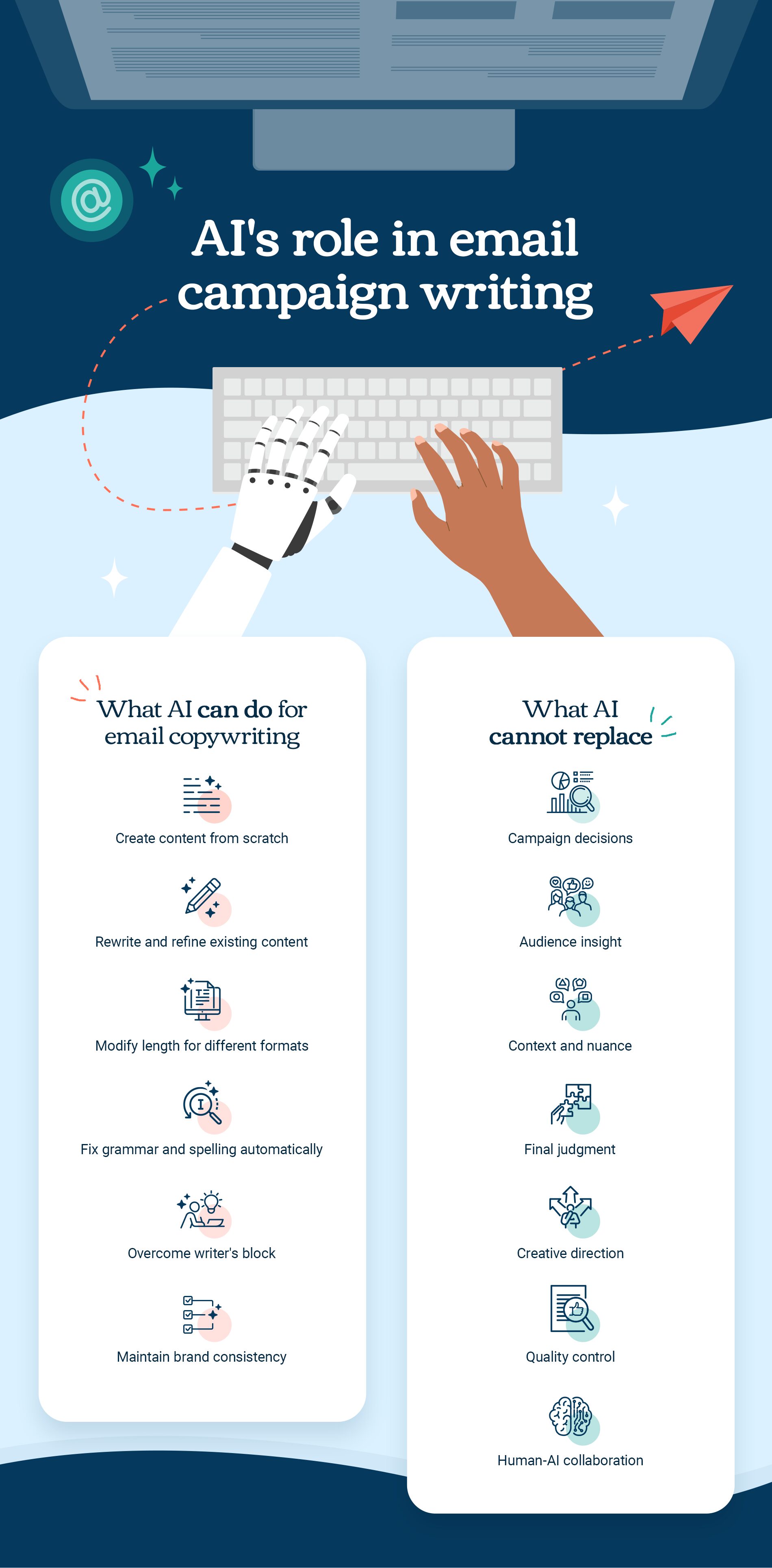
AI email marketing tools can significantly reduce email creation time by handling several key tasks:
- Create content from scratch: You provide a brief description of your goals, and AI creates complete email drafts in seconds.
- Rewrite and refine existing content: AI can improve clarity, adjust messaging, or shift tone from formal to conversational.
- Modify length for different formats: It can expand brief announcements into detailed newsletters or condense long content into quick updates.
- Fix grammar and spelling automatically: AI can catch mistakes that human eyes often miss, even after multiple reviews.
- Overcome writer’s block: It can generate multiple approaches to the same message when you’re stuck.
- Maintain brand consistency: AI can learn your preferred style and apply it across campaigns.
What AI can’t replace
Strategic thinking and final decision-making still rely on human expertise, not AI:
- Campaign decisions: AI can’t determine which products to feature or the best time to launch.
- Audience insight: AI lacks deep insight and emotional intuition in customer relationships.
- Context and nuance: While it can personalize your message using data, it can’t fully grasp human context.
- Final judgment: Choosing the right subject line requires alignment with brand voice and goals.
- Creative direction: Groundbreaking ideas come from human imagination, not algorithms.
- Quality control: AI outputs need human review to ensure accuracy and appropriateness.
- Human-AI collaboration: The best results come from guiding AI and refining its output.
Write your first draft with AI
The hardest part of writing any email campaign is getting started. AI email campaign tools help you move from a blank page to a working draft in minutes instead of hours.
Create effective AI prompts
When crafting your prompts, start with your core message and clearly tell the AI what you want the email to accomplish. Include key details like your target audience, the offer or information you’re sharing, and any specific points that must be covered to guide the AI effectively:
- Specify tone: Explicitly state if you want the email to sound professional, friendly, urgent, or educational.
- Define length: Mention your preferred word count, as whether you need 50 or 250 words significantly impacts the AI’s generation.
- Provide context: More details yield better results. For instance, rather than “Write about our spring sale,” you might say “Write a 150-word email for existing customers announcing our spring sale, highlighting 25% off home goods. Use a friendly, enthusiastic tone and include a clear call to action to shop now.”
This level of specificity can yield drafts that require minimal revision.
Draft email subject lines
When drafting email subject lines, use AI to generate multiple options with a single prompt. Ask the AI for 5-10 variations, then review them to identify the strongest performers and test different approaches like questions, statements, or benefit-driven headlines:
- Vary the tone: Rewrite subject lines in different tones to discover what resonates best, recognizing that a casual subject line might not suit a formal context and vice versa.
- Prioritize opens: Remember that making your email copy effective begins with compelling subject lines designed to encourage opens.
- A/B test: Consider A/B testing AI-generated subject lines against your traditional methods.
- Combine approaches: You might find that AI-generated styles outperform your usual approach, or that a combination of AI suggestions and your own intuition yields the best outcomes.
Write the email body content
To write the email body, enter your key message and let the AI generate a complete draft. Create multiple versions to compare different approaches, such as more direct messaging versus narrative-driven content:
- Expand for detail: Expand bullet points into full paragraphs when you require more extensive detail.
- Condense for clarity: Convert dense paragraphs into scannable lists when clarity is prioritized over elaborate prose.
- Segment audiences: Generate variations for different audience segments without needing to start from scratch each time.
- Apply your expertise: Your expertise is crucial to transform these drafts into compelling and effective emails. Remember to treat AI-generated output as a draft rather than a final product.
Use AI to improve clarity
Once you have a draft, AI can help you refine your message so it resonates with your audience. Effective email campaigns rely on clear, focused communication that readers can quickly grasp and act on. For robust email campaign optimization, here’s how AI helps with clarity:
- Adjust tone and voice: Shift formality levels with simple instructions. A draft written for executives can be rewritten for frontline staff in seconds. Test different tones like professional, personal, empathetic, or enthusiastic to see which connects best with your audience.
- Modify length and complexity: Shorten content for mobile readers who scan. Many readers access emails on their phones, making concise, scannable content essential. Expand messages when comprehensive information is needed, or simplify complex topics by requesting lower reading levels.
- Fix grammar and spelling: Automated error detection catches typos, punctuation mistakes, and grammatical issues before you send. This feature reduces manual proofreading time and ensures a professional product that reflects well on your brand.
Personalize content at scale
Personalized emails typically deliver higher transaction rates, but creating unique content for different segments used to be prohibitively time-consuming. AI makes the process more efficient.
Writing for different audience segments
Adapt your core message for different audiences without rewriting it from scratch. For example, a message to new subscribers might focus on onboarding, while the same promotion for loyal customers could highlight exclusive benefits and early access:
- Maintain consistency: Create segment-specific variations that address each group’s unique needs and interests while keeping the overall message consistent.
- Use illustrative examples: A nonprofit, for example, might send a donation appeal to first-time donors emphasizing its mission. Meanwhile, long-term supporters would receive a version showcasing specific programs their past contributions have funded.
- Scale personalization: AI is instrumental in scaling personalization efforts without increasing your workload.
- Boost efficiency: With AI, you can generate dozens of segment variations in the same amount of time it would take to manually write just a few.
Adapting content for different campaign types
Welcome emails need a different approach than newsletters. Event invitations require a different language from product launches. AI can shift style and structure to match campaign type while keeping your brand voice intact.
Segmented campaigns can generate substantial revenue increases. Tailored and personalized emails often lead to stronger engagement and higher click-through rates. These improvements compound when you can efficiently create personalized content at scale.
Different campaign types also benefit from different content structures. Welcome emails work best when navigation and next steps are clear. Newsletters need compelling headlines and scannable sections.
Product announcements should lead with benefits before features. AI can adapt your content to match these structural needs while maintaining your core message.
Overcome AI email marketing challenges
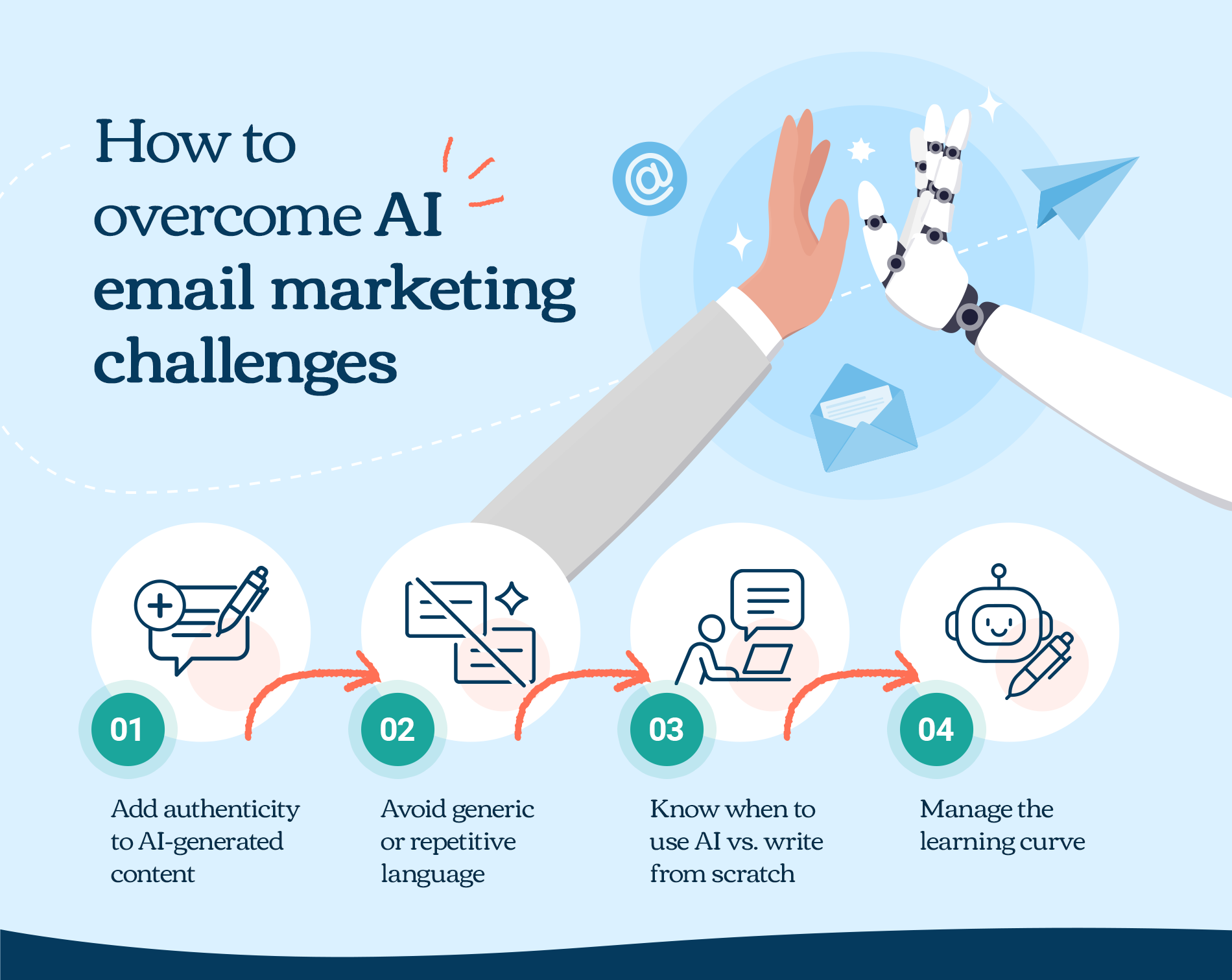
Every marketer faces similar hurdles when adopting AI for email writing. Here’s how to navigate the most common challenges.
1. Add authenticity to AI-generated content
AI is a helpful starting point, but authenticity comes from human input. Always refine outputs to reflect your brand and customer relationships:
- Review and edit: Always check AI-generated content before sending.
- Add specificity: Include details unique to your customers, products, and brand story.
- Use AI as a foundation: Let AI handle structure and initial drafts.
- Prioritize human connection: Layer in personality and genuine tone to make the content engaging.
- Focus on experience: Be sure to prioritize authentic customer experiences, even when AI does the heavy lifting.
2. Avoid generic or repetitive language
Without variation, AI can produce repetitive or formulaic content. Actively guide it to keep messaging fresh and engaging:
- Vary prompts: Use different prompts, even for similar topics.
- Set boundaries: Tell AI which phrases or styles to avoid.
- Iterate outputs: Rewrite multiple times with new instructions to improve originality.
- Blend content: Combine AI-generated text with your own writing.
- Use diverse inputs: Varying inputs leads to more natural, less repetitive outputs.
3. Know when to use AI vs. write from scratch
AI isn’t necessary for every task. Knowing when to rely on it and when not to helps maintain quality and efficiency:
- Routine campaigns: Use AI for newsletters, product updates, and standard announcements.
- High-stakes emails: Start with human input for launches, crisis communications, and personal messages.
- Brainstorming support: Use AI to generate ideas and first drafts.
- Final decisions: Keep judgment and approvals human-led.
- Balanced approach: Start with AI for efficiency, and finish with human expertise for impact.
4. Manage the learning curve
Adopting AI tools takes time and practice. A gradual approach helps you build confidence without disrupting your workflow:
- Start small: Begin with one campaign type, such as a weekly newsletter.
- Practice prompting: Experiment with different prompts to learn what produces the best results.
- Save what works: Build a library of effective prompts.
- Expand gradually: Increase AI usage as your confidence grows.
- Prioritize skill development: Take a measured approach to integrate AI smoothly into your process.
Best practices for your AI email campaign
Following these best practices will help you get the most value from AI while maintaining the quality your audience expects.
Start with clear objectives
Define success before you begin writing. Know what you want your email to accomplish and what matters to your audience. Decide how you’ll track whether your AI-assisted approach is working.
Clear objectives guide every decision you make, from prompt creation to final edits. An email designed to drive immediate purchases needs a different language than one designed to educate subscribers about a complex topic.
Provide specific prompts
More detail produces better output. Include context about your audience, your brand, and your goals. Specify what you want and what you don’t want. Vague prompts generate vague content. Detailed prompts generate focused, relevant drafts that need less revision.
Prompts are like creative briefs. The more information you provide up front, the closer the first draft will be to your vision. Include details like word count, tone, key points to cover, calls to action, and any phrases or approaches to avoid.
Review and edit before sending
AI can make mistakes, so human oversight is nonnegotiable. Check for accuracy and brand alignment. Verify that the tone matches your intentions, adding personal touches that make the email distinctly yours. Ensure all links work correctly and dates are accurate.
Human involvement is essential to ensure quality and contextual appropriateness. Never send AI content without a thorough review.
Test and measure
Compare AI-assisted campaigns to your baseline performance, and track which prompts generate the best results. Refine your approach based on data, not assumptions. What works for one audience might not work for another.
Document what works. When a particular prompting strategy produces excellent results, save it for future campaigns. Over time, you’ll build a library of proven approaches that consistently deliver strong performance.
Balance efficiency with authenticity
Use AI to save time on drafting without eliminating human judgment. Let AI handle structure and initial language, while humans add the soul that makes emails connect emotionally with readers.
Rather than producing more emails faster, the goal is to create better emails in less time. A streamlined process lets you focus more on strategy, testing, and building relationships with your audience.
When to use AI for different campaign types
Not all campaigns benefit equally from AI assistance. Here’s when AI can help most and when to proceed with caution.
Ideal use cases for AI-assisted writing
AI usually delivers strong results for these common campaign types:
- Weekly newsletters: Their consistent format and recurring topics make them ideal for AI assistance.
- Product or event announcements: Straightforward information benefits from AI’s ability to structure content clearly.
- Welcome series: Onboarding sequences often follow predictable patterns that AI handles well.
- Seasonal campaigns: Holiday promotions and seasonal messaging can be generated quickly with appropriate prompts.
When to apply extra caution
These situations require more human oversight and involvement:
- Crisis or sensitive communications: Tone matters enormously, and AI can miss emotional nuance.
- High-stakes launches: Major product releases or strategic announcements need human strategic input throughout.
- Personal or emotional appeals: Fundraising for causes or addressing difficult topics requires an authentic human voice.
The future of AI in email campaign writing
AI capabilities continue to evolve, but the fundamental principle remains the same. AI enhances human creativity rather than replacing it.
This technology is evolving rapidly in marketing, with smarter personalization and deeper data integration on the horizon:
- Advanced personalization: AI will learn individual customer preferences and history more precisely.
- Brand voice refinement: AI will improve consistency by learning nuanced communication styles.
- Analytics integration: AI will help determine not just what to write, but when to send and to whom.
- Data-driven insights: AI will handle complex analysis to inform smarter marketing decisions.
- Scalable personalization: AI will enable hyper-personalized campaigns at a previously impossible scale.
- Evolving team roles: Marketing teams will increasingly rely on AI for efficiency and strategic support.
Building skills for the AI era
Effective collaboration with AI can help you succeed as an email marketer. Develop your prompting skills, and know what AI does well and where it falls short.
Stay curious about new capabilities as they emerge. Your strategic thinking, audience insight, and creative judgment remain irreplaceable. AI gives you more time to apply those skills where they matter most. With the right approach, you can effectively use AI for email campaigns while maintaining an authentic voice that your audience trusts.