
When your email marketing calendar is built around whatever’s most urgent, sends can start to feel rushed and reactive. You’re approving campaigns at the last minute, scrambling to fill gaps in the schedule, and wondering why engagement stays stuck.
If this sounds familiar, you’re not alone. Explore how creating a more intentional email sending rhythm can lead to better engagement. You’ll learn how to audit your current approach, define a sustainable sending schedule, and use technology to maintain consistency without burning out your team.
The downsides of reactive email marketing
Reactive email marketing happens when your calendar is built around available bandwidth instead of subscriber needs. You send when you have time, skip sends when you’re busy, and adjust frequency based on internal priorities rather than audience expectations.
Over time, that kind of reactive rhythm can create a few familiar problems:
- Subscribers ignore your emails: When they can’t predict when you’ll appear in their inbox, they may stop looking for your messages.
- Increase in team stress: Every send becomes a rush job, quality suffers, and your team focuses entirely on execution while strategy gets pushed aside.
- Less clarity around what’s working: Without consistent timing and frequency, you can’t tell whether poor performance is due to message content, send time, or audience fatiguaut.
The shift from reactive to intentional starts with recognizing these patterns and putting a few simple systems in place.
Signs your email sending needs a reset
Recognizing reactive patterns is the first step toward fixing them. If any of these feel familiar, it’s time for a reset.
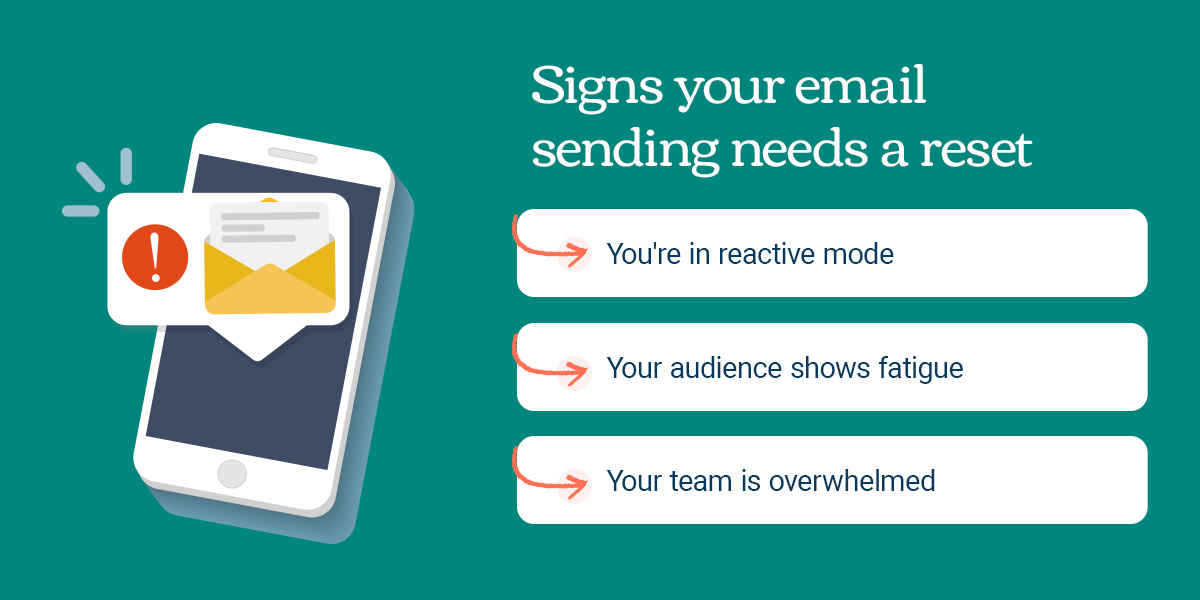
1. You’re in reactive mode
Reactive mode shows up in several ways:
- Last-minute approvals: Your team regularly approves email content hours before the scheduled send because the campaign wasn’t ready earlier.
- Inconsistent frequency: You send three emails one week and none the next, with no strategic reason for the variation.
- Gap-filling sends: You create campaigns primarily to maintain presence, resulting in content that feels forced or off-brand and delivers little subscriber value.
2. Your audience seems fatigued
Subscriber behavior tells you when your rhythm is off. Watch for declining open rates across multiple campaigns, increased unsubscribe rates that don’t correlate with specific content issues, or lower click-through rates even when your content quality stays consistent.
3. Your team is overwhelmed
Team strain can appear through different indicators:
- Constant deadline pressure: Every campaign feels urgent, even for scheduled sends that were planned weeks in advance.
- Quality inconsistencies: Error rates increase, brand voice becomes less consistent, and design standards slip as team members rush to meet deadlines.
- Lack of strategic time: Your team spends all available hours on execution with no time left for testing, optimization, or strategy development.
What to consider when planning your email rhythm
An intentional rhythm gives your team more breathing room. When you know what you’re sending, when you’re sending it, and why it matters to your subscribers, email marketing starts to feel easier to manage.
Audience needs and timing
Organizations have different communication needs depending on their audience and mission. For example, if you serve higher education institutions, your subscribers need different information during recruitment season than during summer break.
Your email marketing calendar should reflect these patterns. Map the subscriber journey by thinking through the moments when your audience is most likely to need information or support from you, and build your rhythm around showing up at those times.
Consistency and flexibility
Your subscribers should know roughly when to expect your emails. You also need room in your schedule to send timely emails when something important happens.
You can balance both by planning your regular sends, such as your weekly newsletters, and sticking to this schedule. You can then leave a few open slots each month for special sends, like a last-minute event invitation, a time-sensitive announcement, or a message triggered by what a subscriber does on your site. With this approach, your regular emails keep you on your subscribers’ radar, while your timely emails show you’re paying attention to what matters right now.
Realistic capacity
Your rhythm only works if your team can sustain it. To figure out what your team can actually handle, track how long it takes to complete a typical campaign from start to finish. You can also leave space for testing new ideas, making improvements, and handling the unexpected requests that always come up.
Building your intentional email rhythm
Creating an intentional rhythm starts with understanding where you are now, deciding what content matters most to your audience, building a schedule your team can sustain, and setting checkpoints to keep improving.
1. Audit what you’re sending now
Start by documenting every email you sent in the past 90 days. Record the send date, campaign type, audience segment, and performance metrics. Look for patterns in timing, frequency, and performance.
From there, identify your most consistent sends, your highest-performing campaigns, and any notable gaps or clusters in your schedule. This gives you a clearer view of what’s already working, where your schedule feels steady, and where last-minute sends are making things harder to manage.
2. Define your core email content pillars
Content pillars are the recurring themes that form the foundation of your email sending schedule. For a university, pillars might include academic programs, campus life, admissions guidance, and alumni stories. But for a nonprofit, pillars might cover impact updates, volunteer opportunities, donation appeals, and educational content.
Define a few pillars that align with subscriber needs and your organizational goals. Each pillar should be:
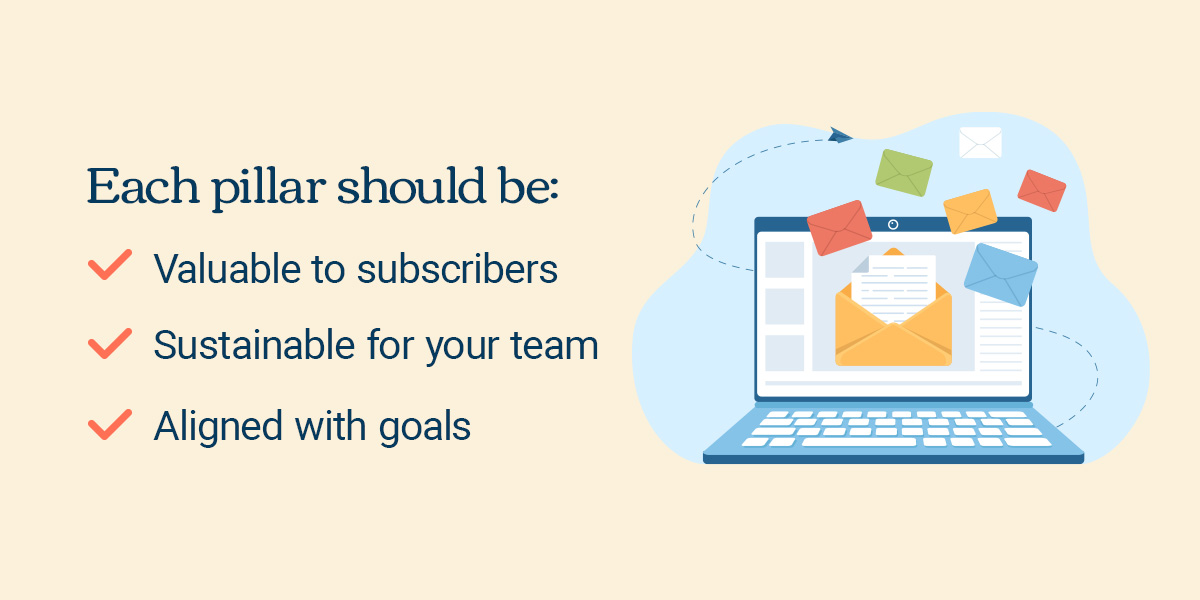
- Valuable to subscribers: It addresses a need, interest, or question your audience actually has.
- Sustainable for your team: You can create quality content in this category without constant scrambling.
- Aligned with goals: It supports your broader marketing and organizational objectives.
3. Map your ideal rhythm
Use your content pillars to build a sustainable sending schedule. Start with a realistic starting point by determining the lowest frequency that keeps you present and valuable to subscribers. For most organizations, this might mean sending at least one email per month. Some audiences need weekly contact, while others prefer monthly or quarterly updates.
Assign each pillar to specific send slots. For example, a university might send a weekly newsletter covering all pillars, while a nonprofit might alternate between impact updates and engagement opportunities.
4. Build in review and adjustment points
Monthly reviews should track performance metrics, team workload, and subscriber feedback. Quarterly reviews should evaluate your overall rhythm, test timing variations, and adjust content pillars based on subscriber engagement.
These reviews keep your rhythm intentional as you’ll be making strategic adjustments based on data rather than guesswork.
Common rhythm-building mistakes to avoid
You now have a clear process for building your intentional rhythm. As you implement these steps, watch out for three common pitfalls that can pull you back into reactive mode.
Copying email cadence without context
Generic benchmarks for optimal email frequency don’t account for your specific audience, content quality, or organizational capacity. Use benchmarks as starting points for your own testing. Test different frequencies with your audience and measure the results. Your optimal rhythm is the one that keeps subscribers interested without overwhelming them or your team.
Planning too far ahead without flexibility
Your rhythm should provide structure while allowing flexibility. Think of your rhythm as a guide, not a rigid rule. If something important happens or your audience signals a need, you should be able to respond without throwing your entire plan off track.
Review and adjust your rhythm quarterly based on performance data and changing subscriber needs. What works in January might not work in July, and that’s okay.
Ignoring your team’s capacity
The best email rhythm is one that you or your team can repeat without scrambling. Start with a schedule you can execute well, then add more sends once your workflows feel steadier and your team has room to test what works.
How email marketing technology supports your rhythm
The right email marketing tools make it easier to keep your email cadence consistent, even when your team is stretched thin or priorities change unexpectedly.
Automation protects your rhythm from daily chaos
Email automation keeps your rhythm running even when your team is pulled in different directions. Instead of worrying whether someone remembered to schedule this week’s newsletter, you can focus on strategy and content quality.
Set emails to send at optimal times, and your rhythm maintains itself without last-minute scrambles or missed sends. Recurring sends welcome series, re-engagement campaigns, or milestone messages—run without requiring manual intervention for each subscriber, so your team can focus on the work that requires human judgment and creativity.
Segmentation prevents over-sending
An intentional rhythm includes personalized content for different subscriber groups. Segmentation tools let you maintain consistent contact while varying content based on subscriber interests, behavior, or profile data. One study reports that including personalized calls to action (CTAs) in emails converts 202% better than standard CTAs.
For example, a university can send weekly emails to all subscribers while customizing content for prospective students, current students, alumni, and donors. This means you stay present without worrying that you’re sending irrelevant content to people who only care about specific topics.
Reporting informs rhythm adjustments
Regular reporting helps you refine your rhythm over time without second-guessing every choice. Track performance by send day, send time, frequency, and content type. Look for patterns that indicate optimal timing for your audience. Use those patterns to decide what to change next, without second-guessing every send.
Making the reset stick: Maintaining your intentional rhythm
These three practices keep your intentional rhythm from slipping back into reactive chaos when deadlines pile up or stakeholders request last-minute campaigns.
Create guidelines your team can follow
Document your email marketing calendar structure, content pillar definitions, and approval processes. Include details about who creates content for each pillar, how far in advance campaigns should be drafted, and what metrics you use to evaluate performance.
Communicate your new rhythm to stakeholders
Share your email marketing calendar with stakeholders who request ad-hoc sends. When a department asks for an immediate campaign, you can show them where it fits in the schedule and discuss trade-offs. This visibility can help stakeholders understand what your team can realistically take on and plan their requests accordingly.
Schedule regular check-ins
Monthly team meetings should review upcoming sends, discuss performance trends, and identify needed adjustments. Quarterly strategy sessions should evaluate your overall rhythm and test new approaches. These check-ins keep everyone aligned and prevent them from drifting back into last-minute mode.
Frequently asked questions about email cadence
Here are a few common questions about building a more intentional email cadence.
1. How long should an email nurture sequence be?
The most important factor isn’t the length, but the value provided in each message. The goal is to build trust and educate your subscribers, not just hit a certain number of sends. Test different sequence lengths with your audience and let engagement data guide your decision. If readers are dropping off after email three, you might be sending too many. If they’re still engaged and clicking through email seven, you might have room to extend the sequence.
2. What are the most important email cadence best practices to follow?
The best practices that matter most are the ones that put your audience first. Start by understanding your subscribers’ expectations through engagement data and behavioral signals, then build consistency into your schedule while leaving room for timely opportunities. Test your cadence regularly with different audience segments and monitor your metrics closely.
3. Is sending more emails the answer to low open rates?
A low open rate is a symptom, not the root problem. Before you adjust your sending volume, you’ll need to first look for the cause. First, use the audit steps to find the real problem, then adjust your content and targeting. It’s relevance, not volume, that drives opens.
4. How do I convince my boss or sales team that sending fewer emails can be a good thing?
Use data to build a business case. Use the audit you performed to show them the numbers. When stakeholders see that your proposal protects your email list while improving results, they may be more likely to support the change.
Build a rhythm your team can keep up with
When email feels reactive, it’s harder on your team and less useful for your subscribers. There’s a more sustainable way to approach it—one where your team has breathing room to think strategically and your subscribers look forward to hearing from you.
Emma gives your team the tools to make email marketing easier. From automation that keeps your sends on track to reporting that helps you refine your rhythm over time, Emma’s email marketing tools are designed to make consistent email marketing easier to maintain.