
You’re running social media, writing the newsletter, tweaking the website, and still need to get a content calendar up for next quarter. There’s no dedicated tech team backing you, and the budget only stretches so far. Every tool you add has to earn its place—whether that means saving time, filling a gap your small team can’t cover alone, or building a foundation that still makes sense when you hire your next employee.
The good news is that a lean stack of the right tools can do more than most people expect. Here’s a by-category breakdown of what’s actually working for startup marketing teams in 2026.
Your quick-scan shortlist of the best marketing tools for startups
Think of this as your minimum viable stack—the marketing tools for startups that show up again and again in efficient setups, organized by category. Several are free marketing tools for startups, so you can test the waters before spending anything.
| Category | Tool | Key strength |
|---|---|---|
| CRM | HubSpot | One place for all your contacts, deals, and lead activity |
| Email marketing | Emma | Build, send, and automate on-brand emails your whole team can manage |
| SEO | Semrush | Find the keywords worth targeting and fix what’s quietly holding back your rankings |
| Design | Canva | Professional-looking graphics and decks anyone on your team can put together |
| Social media management | Buffer | Plan and schedule posts across every platform from one clean calendar |
| Web analytics | Google Analytics 4 | See where your traffic comes from and what it does once it gets there |
| Workflow automation | Zapier | Move data between your tools automatically with no code or copy-paste |
Best CRM for startups
It’s tempting to put off a customer relationship management (CRM) tool until you have “enough” contacts to justify one. But keeping leads organized from day one—instead of scattered across spreadsheets, inboxes, and sticky notes—helps a small team know exactly who to follow up with and when. Even a two-person marketing team benefits from a central system that shows who’s interested and what stage they’re in.
HubSpot works well here because its basic CRM tier covers the essentials most startups need:
- Contact records
- Deal tracking
- Email integration
On top of that, HubSpot tracks lead activity and plugs into the other marketing platforms in your stack.
Best email marketing tool for startups
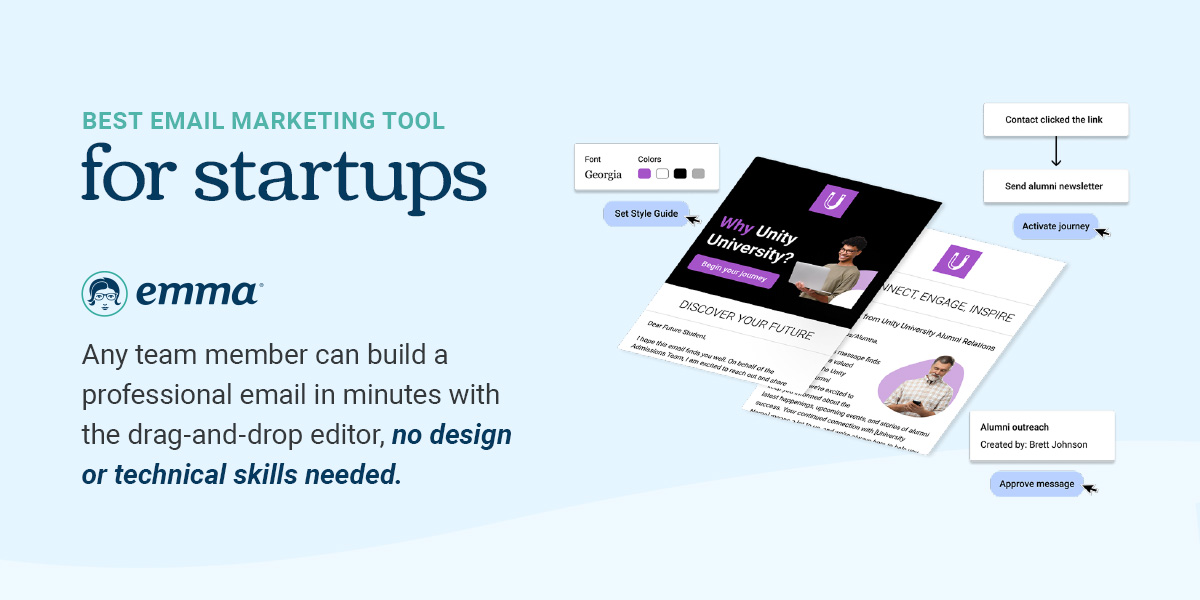
Most tools for startups handle the basics of sending campaigns. Emma goes further—keeping those campaigns consistent and on-brand as your team grows, which is the hardest part to maintain. Any team member can build a professional email in minutes with the drag-and-drop editor, no design or technical skills needed.
You also get email automation workflows that handle the repetitive stuff, like an automated welcome series that kicks in the moment someone subscribes.
As you add people or locations, brand controls and approval workflows keep every email looking and sounding like your brand, not whoever happened to hit send that day.
With Emma, you also get:
- Advanced segmentation
- A/B testing
- A built-in analytics dashboard to see what’s resonating with your audience
You’ll also find AI-powered Smart Features that help with subject lines, send timing, and content ideas. That mix of ease of use and scalability is why this pick holds up as your team scales.
Best SEO tool for startups
Organic search keeps paying off long after you hit publish, unlike paid ads that stop the moment your budget gives out. That’s why SEO tools for startups earn a spot on this list even with a limited ad budget. You just need to know which keywords to target and where your competitors are winning.
Semrush brings that research within reach without needing an SEO background. The tool helps you find new opportunities before competitors do by:
- Handling keyword research
- Competitor content analysis
- Spotting content gaps
A site health audit zeros in on the technical fixes that will do the most for your rankings.
Best design tool for startups
Most startup marketers wear the design hat without formal training, but every channel still needs to look professional—social posts, email graphics, pitch decks, ad creatives. Canva solves that without sending you to design school first.
The drag-and-drop editor keeps things simple and the template library comes pre-sized for every platform, so your posts fit whether you’re designing for Instagram or LinkedIn. The brand kit feature keeps your colors, fonts, and logo consistent, no matter who’s designing that day.
Best social media management tool for startups
Between writing captions, resizing images, and keeping track of what’s already gone out, regular posting across platforms can take up hours every week for a smaller team. Buffer takes the pain out of that daily grind.
You can schedule posts across LinkedIn, Instagram, Facebook, X, and TikTok from one clean content calendar, then check post analytics to see what’s landing with your audience. That combination makes Buffer one of the better social media management tools for startups juggling more than one channel.
Best web analytics tool for startups
Many startup marketers eventually ask the same question. Is any of this working? Google Analytics 4 (GA4) answers it for free with:
- Traffic sources
- On-site behavior
- Conversions
- Audience breakdown
GA4 does have a learning curve. The interface takes some getting used to, but no other free tool gives you this much visibility into what’s actually driving results. In fact, 51% of the top million sites globally use Google Analytics for traffic and performance tracking—which means most of your competitors already have this data working for them.
For a startup that needs clear, useful numbers without adding another line item to the budget, GA4 delivers exactly that.
Best workflow automation tool for startups
Once you have a CRM, an email tool, a social scheduler, and an analytics platform, information still has to move between them somehow—whether that’s copying a new lead from a form into your CRM or adding them to your email list by hand. Zapier removes that manual step without a line of code.
It works through trigger-action “Zaps” that automatically connect your apps. When a new lead fills out a form on your site, Zapier can add them to Emma and notify your team in Slack at the same time. No copy-paste required.
Zapier connects more than 9,000 apps, making it one of the more flexible small business marketing tools out there—and one that keeps working as your startup marketing tech stack grows.
See how Emma fits your startup’s stack
A handful of the right marketing tools for startups is often all it takes for a lean stack to work well, and email is usually the first channel that delivers results you can actually measure. It’s also the channel that most directly builds the audience your startup owns, rather than one you’re renting from an algorithm.
Emma grows with you. The drag-and-drop editor means anyone on your team can put together a professional email, no design skills needed. When it’s time to add people or locations, the same brand controls keep every email looking and sounding like you. Automation takes care of the recurring sends so you don’t have to think about them.
Ready to see it in action? Request a demo and find out how Emma fits into your stack.