

A loyal donor opens her inbox on Monday morning and sees an urgent appeal from your nonprofit’s Chicago chapter asking for emergency funds. By Wednesday, your Denver chapter sends a cheerful newsletter celebrating a fundraising milestone. On Friday, the national headquarters launches a matching gift campaign. Three emails, three different tones, and three conflicting messages—all from the same organization.
When chapters operate independently, your brand can feel a little disconnected—and that can make it harder for donors to feel confident about where they’re giving. Keeping nonprofit email marketing consistent across chapters presents a genuine challenge. At the same time, enforcing rigid control from headquarters can get in the way of the authentic local connections that make chapters so effective.
The good news? You can build a framework that protects your brand while giving chapters the freedom to connect with their communities in meaningful ways.
Why email consistency protects your donor relationships
When donors receive conflicting messages from different chapters, it can leave them feeling uncertain about your organization. A study on nonprofit branding found that donors are more likely to give when they see alignment between their ideal charity and a nonprofit’s actual brand.
For chapter-based nonprofits, that makes consistency especially important—every local email helps shape how donors understand the larger organization.
When chapter emails feel disconnected from one another, a few things can happen:
- Donor confusion: When messaging varies across chapters, it’s harder for donors to understand what your organization stands for.
- Harder to build trust: When your brand feels inconsistent from chapter to chapter, donors may hesitate before deciding to give.
- Volunteer uncertainty: When messaging varies widely across chapters, it’s tougher for team members to confidently represent your organization.
- Missed opportunities: When chapters take conflicting approaches, your campaigns can’t build on each other the way they could with better coordination.
Research on nonprofit communication shows that how you frame your messages—whether uplifting or urgent—affects how donors respond. Consistent communication across every email helps keep those relationships strong.
What to standardize and what chapters can customize
When everyone understands which email elements should stay the same and which can be customized, chapters can create emails that feel consistent and authentic.
1. Keep these elements consistent
Some things should stay the same across every chapter, no matter who’s sending. Your non-negotiables include:
- Sender name standards, so donors immediately recognize your emails
- Visual identity elements, including logo, brand colors, and typography
- Legal compliance components like unsubscribe links, privacy disclosures, and required nonprofit language
- Core mission statement and organizational values, stated the same way everywhere
- National campaign messaging for major initiatives and advocacy efforts
These are the building blocks of a strong nonprofit brand experience. Keeping them uniform across chapters helps donors recognize your organization, no matter which chapter is reaching out.
2. Give chapters templates they can make their own
For nonprofit organizations with lots of chapters, templates create efficiency without sacrificing authenticity. Think of email templates like a happy medium between a completely blank slate and a rigid, pre-written script.
You can make email templates organized by campaign type:
- Fundraising appeals
- Event invitations
- Volunteer recruitment
- Donor stewardship
Each template locks in branding with clearly marked, customizable content areas. Consider also providing subject line suggestions that chapters can adapt, and give structures that have worked in the past, like “Your [local impact] made this possible” or “[Chapter name] needs your help with [local initiative].”
Including example copy in each template also helps chapters get the tone right without having to start from scratch every time.
3. Make room for local stories
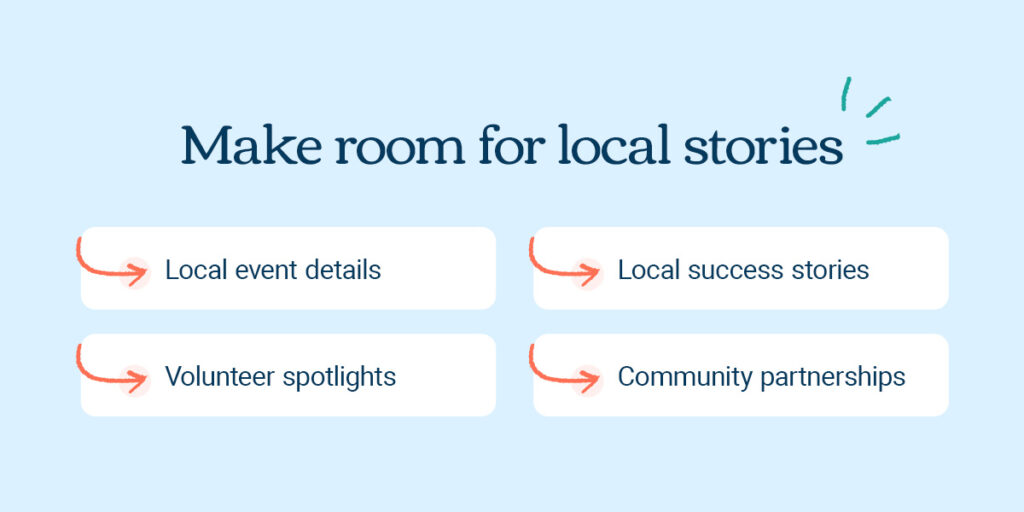
Some content works best when it comes directly from the chapter. Local teams are closest to the people, partnerships, and stories that make the message real.
Chapters can customize:
- Local event details.
- Volunteer spotlights.
- Local success stories.
- Community partnerships.
Think about it this way: when your Austin chapter shares how it served 500 families this quarter, that story has the most impact when it comes from the people doing the work. Local stories, told by the people closest to them, are some of the most compelling content your organization can share.
Building systems that make consistency easier
Having a brand guide is a great start. But real consistency also needs systems that make it easy for chapters to stay on the same page with your national brand.
Your chapters are busy serving communities, managing volunteers, and meeting local goals. If staying on-brand calls for extra effort, it won’t happen all the time. When the right systems are in place, consistency is much easier.
Organizations with distributed structures—from nonprofits to public sector teams—often do well when they combine centralized brand control with local flexibility. This approach supports nonprofit brand consistency across chapters while giving local teams room to connect authentically.
Organize templates by campaign type
Build your template library so chapters can easily find what they need for:
- Fundraising.
- Events.
- Stewardship.
- Volunteer recruitment.
- Advocacy.
You can set permissions so your national team can manage the template library while chapter leadership uses approved templates without changing locked elements.
When templates are easy to find and use, chapters are more likely to reach for them.
Share resources and coordinate send timing
With Emma, you can build a centralized content library with approved images, your organization’s stats, boilerplate copy, and pre-written descriptions. You can even provide campaign-specific resources, like a lapsed donor reengagement email template. When chapters have easy access to quality assets, they’re less likely to create their own alternatives that drift off-brand.
When you set up a master send calendar that everyone can see, it helps you avoid situations where donors receive three emails in two days. Consider blocking out windows around major campaigns and help chapters plan their send timing so nothing overlaps. This protects the donor experience and helps reduce unsubscribes.
Support your chapter teams
One of the best ways to support your team is to offer training that goes beyond the brand guide. Show chapter teams how to customize templates and get the most out of your systems.
Then build a feedback loop that celebrates success. When your Seattle chapter writes a thoughtful volunteer recruitment email, this is a great opportunity to share it with everyone as a model. Combine this recognition with support channels for quick questions—whether that’s a Slack channel, office hours, or a help desk—so chapters know help is always available.
Over time, this peer visibility and support help every chapter communicate in ways that truly support your goals.
How the right platform makes consistency easier
The right platform makes it easier to keep chapters in sync while giving them the space to tell their own stories. Look out for a platform that has:
- Multi-user permissions: Decide who can create, edit, approve, and send communications at national and chapter levels. This control helps chapters have access while protecting brand-critical elements.
- Template libraries with locking controls: Allow chapters to customize designated areas without touching locked elements. Visual cues show which sections can be edited.
- Shared asset libraries: Make approved content easy to find and use. With centralized images, statistics, and copy, chapters can spend less time creating and more time connecting with donors.
- Centralized reporting: See what’s happening across chapter activity. Find trends, spot issues early, and recognize high-performing chapters.
- Built-in AI writing tools: Help chapters draft personalized donor emails and other messages while staying on brand.
Shriners Hospital for Children is a great example. By consolidating 22 hospital accounts under pre-approved templates, the organization gave each location the flexibility to customize while keeping emails in step with the national brand.
Keep every chapter connected with Emma
Managing email across different chapters gets easier when everyone has clear guidelines and the right tools. Emma helps nonprofit headquarters manage brand standards while giving chapters what they need to show up consistently for their local communities.