

Launching an SMS marketing strategy can take a lot of work, but the possibility of a high ROI makes it worth the effort.
With 26% of consumers confirming that they have made a purchase from a marketing SMS they had received in the last year, according to Marigold’s 2025 Consumer Trends Index, and considering that 95% of SMS messages are opened and responded to within three minutes of receiving them (according to SMS Comparison USA), formulating a strong SMS marketing strategy promises to help your brand achieve substantial consumer engagement. Keep reading to learn the must-know advice for achieving the gold standard of SMS marketing.
Stay compliant with government legislation
Industry guidelines may vary depending on what country (or state) that you’re sending to. However, there are some principles that we recommend following, regardless of where your audience is.

- Explicitly asking for permission before sending any text messages to your audience-we recommend doing this via sign-up or subscription form; you should preserve evidence that your customers have opted in to receive SMS marketing
- Making your sign-up CTAS clear, so consumers know what you’ll text them and how many messages they can expect each month
- Including your company name in every message you send to identify it as a marketing communication
- Sending your texts during business hours-typically between 8 a.m. and 9 p.m. local time-although you’re likely to receive the best response between mid-morning and mid-afternoon
- Including information about how to opt-out in every SMS message (Reply STOP or include a link to unsubscribe)
Always make sure to refer to the relevant legislation in the country you’re sending to: Sending to the U.S.
Send your messages at the right time

Once you’re ready to reach out to your customers with SMS, consider sending your messages at the most optimal times for the best results. While every individual uses their phone at different times of day, the average consumer checks their messages almost 11 times a day or more. Industry regulations dictate sending messages between 8 a.m. and 9 p.m. so as not to be intrusive, disruptive, or annoying, but audiences are most likely to respond and take action between mid-morning and mid-afternoon.
If you’re sending your messaging far and wide, be sure to accommodate for different time zones to ensure that you are not sending during off hours. And, while most days of the week are fine for sending messages, Sundays typically have the lowest amount of engagement, so unless you have a particularly good and timely reason to send on a Sunday, it’s best to wait.
Send your messages at the right frequency
When you finally have a contact list and marketing that you want to send, it’s important to find the right cadence and rhythm with which you send your messages—that means sending at the right frequency to elicit the most responses. The optimal send frequency for SMS marketing is one message per week.
Start with one per week, and once you grow your list large enough to collect meaningful data, you can try testing your send frequency. But, be sure that your marketing isn’t presenting as spam to your customers—make sure your messages are worthwhile.
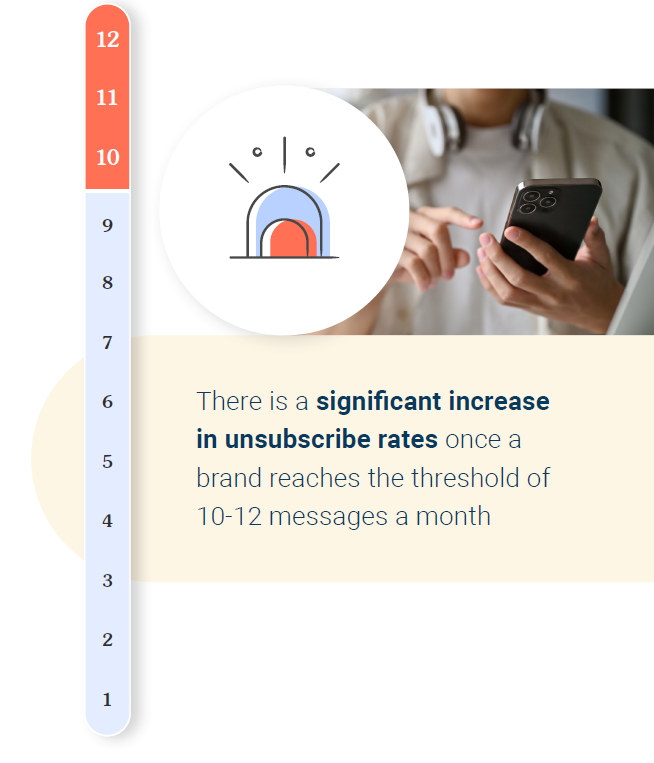
Data shows that there is a significant increase in unsubscribe rates once a brand reaches the threshold of 10-12 messages a month. The most important aspect of sending frequency to keep in mind is that text messages interrupt your customers. Therefore, everything you send must be worth an immediate read, and if it’s not, you’re betraying the trust and the relationship you’ve built with your readers and risking disengagement and opt-outs.
There is a significant increase in unsubscribe rates once a brand reaches the threshold of 10-12 messages a month.
Use SMS as a part of a larger multi-channel strategy
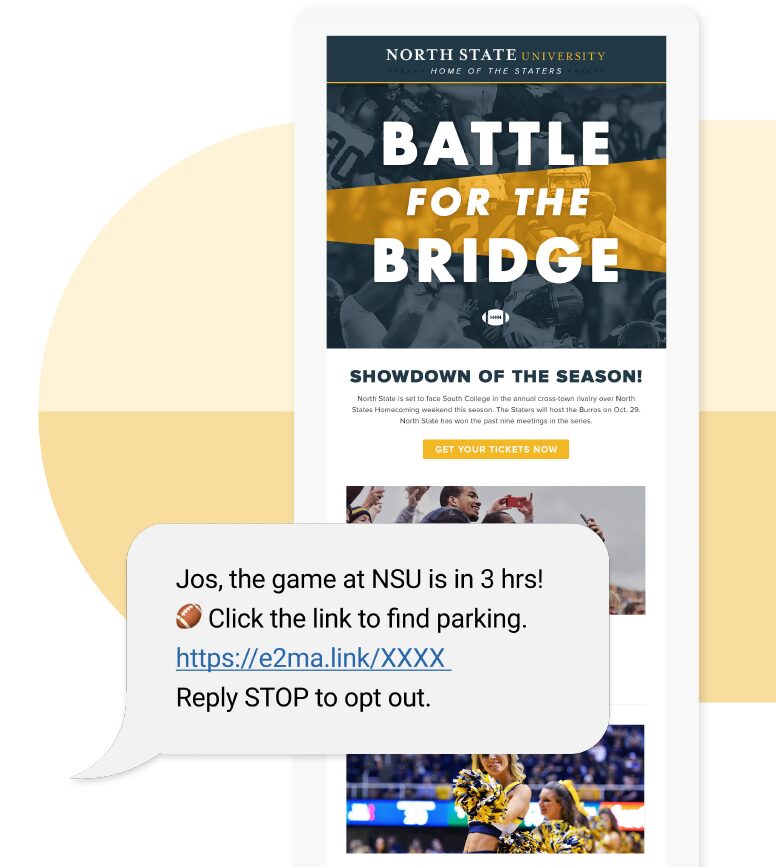
In today’s digital age, SMS and email have proven to be two of the best channels to reach your audience and elicit engagement, which is no surprise given that email and SMS are the top two preferred channels for receiving brand updates.
With this in mind, your SMS marketing strategy should be integrated with your other marketing efforts. By understanding the role each channel plays, you can start to map out when you should use one over the other, and when you should use them in combination.
For example, with no character limits, an email about a new launch or announcement will allow you to provide all the details that your customers need to know, while an SMS is the perfect channel for notifying them that a new announcement email is in their inbox, or to direct them straight to your website for the information. For events, email is great for sending invites as it allows you to provide details of the event and speakers, while an SMS message can be used as an event reminder—for people that live on the go, reminding them of an event they’ve registered for will ensure they see it no matter where they are.
While there are tons of ways you can use email and SMS together to create an engaging multi-channel marketing strategy—by leveraging them both, you can connect with your audience in the channel that’s most convenient, while driving greater engagement.
Using some more marketing examples, we’ve created a simple table to help you determine which channel to use, when.
Craft SMS messages that customers want to read
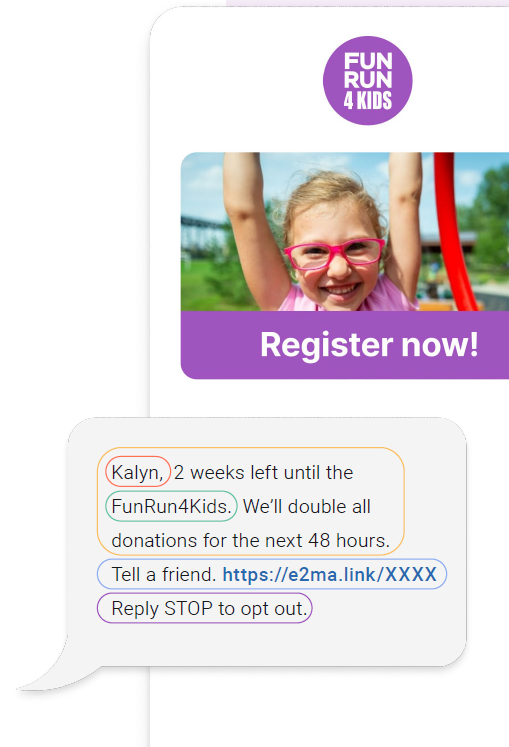
You may not need to develop as much copy for SMS messages as you do email, but there is an art to crafting a compelling message that will drive engagement and conversion, while also being compliant! By following our recommendations below, you’re giving your SMS marketing messages the best chance of eliciting the response you desire.
- Personalization is key when it comes to crafting great marketing SMS messages—you don’t want to make consumers feel like they’re receiving mass communications, so you should use what you know about your audience and their preferences to customize your messages. Messages should sound like they’re for one person rather than your entire marketing list.
- Be concise, but clear. Keep your copy succinct, but don’t go overboard with abbreviations. After all, you want your audience to know what you’re saying without having to think about it. And remember that the character limit for one SMS message is 160 characters, or 70 if you use an emoji.
- Include a clear CTA, such as a URL, to track engagement and conversions (to help save precious character count, Emma will automatically shorten your links for you).
- Include your company name, so your audience can identify who the SMS message is from.
- Embrace a conversational tone of voice. One of the benefits of SMS marketing is that you can be more conversational than you might be able to be in other marketing channels, and we absolutely encourage you to embrace and respect the medium’s primary purpose. Like all marketing channels, you should be consistent with your brand tone of voice, while embracing the more conversational format as it makes sense for your brand.
- And finally, you need to make it easy for your subscribers to opt-out. We recommend you do this by including unsubscribe instructions on all of your SMS messages as follows, “STOP to unsubscribe.”
And don’t forget, like with any marketing message you should lead with something compelling to draw attention—for example, flag a sale as “4 hours only!” or let your subscribers know when a deal is on its way out by telling them it’s their “LAST CALL” to shop.
Test, test, test

Like with any other marketing channel, testing will help you achieve success with your SMS messaging. While we as marketers like to think we’ll know what will work best, it’s best to back those assumptions with data.
The best way, and the only way, to learn about our audience and what will elicit engagement from them is by testing. Try different types of offers, different text lengths, different send times and days—take into consideration the multiple variables that will affect how your customers engage with your messaging—and make note of how they respond with each differing variable.
