

You’ve spent time crafting survey questions that will give you what you need to know, with a logical flow that doesn’t take your audience hours to complete. Then you hit send and watch the open rate fail to reach your goals, disappointing you and the stakeholders involved. Your survey most likely isn’t the problem, you might just need a better, more focused subject line to draw attention.
Surveys matter because they track internal employee engagement and external customer satisfaction and behavior, but they’re only valuable if people respond, which they won’t do if they never even open your email. Getting employees and customers to open your survey is becoming increasingly difficult in a world of survey and email fatigue, hyperprotective spam filters, and readers who expect in-depth personalization.
Compelling subject lines aren’t going to decrease customer email fatigue, but they can do the heavy lifting to increase survey open rates and enable you to optimize every email send. Below, you’ll find 25 proven examples of subject lines that work, plus the strategic context you need to use them confidently.
25 proven survey email subject lines
Each of these 25 survey email subject lines taps into a different psychological trigger, including personalization, urgency, curiosity, or value exchange. Pick a few examples from categories that match your audience, test them against each other, and adapt them to fit your brand voice and goals.
Personalized subject lines
Personalization signals that the message customers are receiving isn’t part of a mass blast, it’s hitting their inboxes for a specific reason. Effective email personalization strategies go beyond including someone’s first name to include location, recent behavior, their current role, or the relationship history they have with your organization:
- “Quick question for our [City] customers”
- “[First name], your feedback shapes what’s next”
- “As one of our longest-standing customers—how are we doing?”
- “You recently [purchased/attended/signed up]—what did you think?”
- “[First name], we’d love your thoughts”
- “Thank you for being with us for [X years]!”
Time-sensitive and urgent subject lines
Humans instinctively respond to deadlines and scarcity. According to the principle of loss aversion, we feel deprivation more sharply than equivalent gains, which is why a quickly closing deadline moves people more than a standing open invitation. However, urgency only works when it’s genuine and used sparingly, as overuse reads as spam and hurts deliverability, so save these ideas for campaigns with a genuine deadline.
- “Last chance to share your feedback—survey closes Friday”
- “Your input needed by [date]”
- “Only 48 hours left—help us improve”
- “We’re closing the survey soon—your voice still matters”
- “Share your experience before the deadline closes”
- “Survey closing soon—don’t miss your chance to be heard”
While urgency can be a powerful trigger, it’s also important to think about avoiding the spam folder. Phrases like “hurry” and “act quickly” can trigger filters, so only use these when there’s a true reason for urgency.
Question-based subject lines
A question creates what psychologists call the curiosity gap, which is an unfinished thought the reader feels a need to resolve. Questions also imply a real two-way conversation, which reduces the “survey blast” feeling and makes customers more likely to respond:
- “How are we doing?”
- “Did we get it right?”
- “What could we do better?”
- “Can you spare 2 minutes?”
- “How was your experience with us?”
- “Quick question—are we meeting your expectations?”
- “What matters most to you right now?”
When you’re crafting compelling subject lines, asking questions is the most natural way to sound human and curious instead of transactional.
Value and incentive-driven subject lines
People usually want to know what they’re going to get out of an interaction. A subject line teases what the reader will get, like a reward, early access, or the knowledge their input creates real change at your organization. Another strategy is to reference how many other employees or customers have already responded, triggering a bandwagon effect and earning you more responses.
Here are some value-driven customer feedback email examples:
- “Take our 2-minute survey and get 15% off your next order”
- “Share your thoughts and get early access to [new feature]”
- “Help us build something better—2 minutes is all we need”
- “Your feedback = real changes. Here’s how we improved last time”
- “Join 500+ customers who’ve already shared their feedback”
- “2 minutes of your time means a better experience for everyone”
These are some great examples to start with, but it’s also important to craft your own subject lines so that they’re more relevant to the audience you know, here’s how you can do just that.
6 best practices for writing survey email subject lines
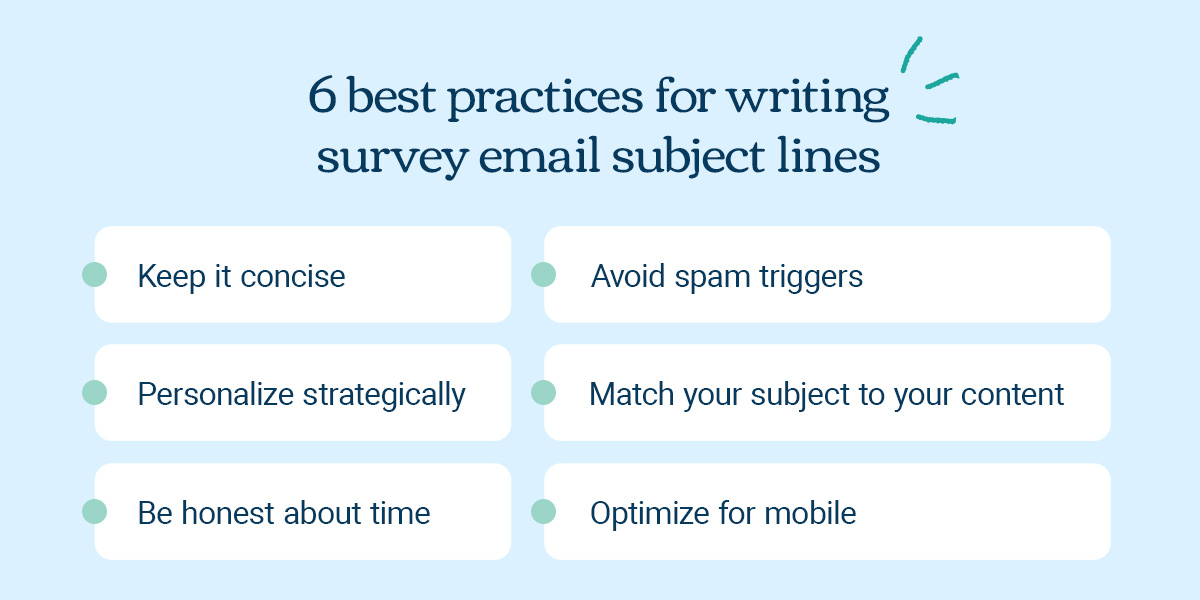
These principles separate subject lines that earn opens from ones that don’t. When you know how to write survey subject lines using these guidelines, you can adapt any example to fit your audience.
- Keep it concise: Aim for a maximum of 10 words and stay under 50 characters so your subject line renders fully on mobile screens.
- Personalize strategically: Go beyond first name when your data supports it. A survey invitation email that references a real action the reader took will consistently outperform one that doesn’t.
- Be honest about time: People will almost always skip surveys if they don’t know what they’re committing to. Remove uncertainty with short phrases such as “2 minutes” or “3 quick questions.”
- Avoid spam triggers: Words like “free,” “urgent,” “act now,” and ALL CAPS can route your message straight to spam. Remember, deliverability outweighs creativity when optimizing subject lines.
- Match your subject to your content: If the subject line specifies “quick,” the survey must be brief. Consistently fulfilling your promises builds trust and helps your next survey campaign perform better.
- Optimize for mobile: Preview text is almost as important as the subject line. Test how both lines look on a phone screen before you send.
5 common mistakes to avoid
Even well-intentioned survey emails fall into these traps.
- Generic subject lines: “We want your feedback” tells the reader nothing. Specificity, such as including a name, a recent interaction, or a direct question, earns opens that vague phrases don’t.
- Inaccurate time estimates: If your subject line promises “2 minutes” and the survey takes 15, trust erodes fast and future open rates suffer. Always test your survey before claiming a time frame.
- Overusing urgency: A single “survey closes Friday” email can inspire people to act. Three “LAST CHANCE” emails in a row train readers to ignore you and can trigger spam filters. Urgency works best when it’s genuine and applied sparingly.
- One-size-fits-all approach: Sending the same subject line to your entire list ignores the segmentation data you already have. Audience segments respond to distinct messaging, and your subject lines should reflect that.
- Ignoring deliverability: Even the world’s best-crafted subject line will earn zero opens if it lands in people’s spam folders. When you’re watching for subject line mistakes to avoid, deliverability should be part of your checklist. Filters look for patterns that feel manipulative, so keep your language honest and specific.
A/B testing your survey subject lines
Every survey subject line is only an assumption until you test to determine how your audience responds. Start testing with these variables:
- Personalized vs. unpersonalized: How much does adding a first name improve opens?
- Question vs. statement format: Does curiosity drive more engagement than clarity?
- Long vs. short: Are you losing opens because the subject line gets cut off?
- With vs. without incentive mention: Does calling out the reward drive clicks?
- Emoji vs. no emoji: Some audiences respond well to visual cues, while others find them unprofessional.
Always pay attention to these metrics:
- Open rate: Is the subject line earning the open?
- Click-through rate: Are they engaging with the email after opening it?
- Completion rate: Did people actually finish the survey?
When you start A/B testing your email campaigns, focus on one variable at a time. Emma’s built-in subject line split testing tool makes this task straightforward—you can compare performance in real time and apply what you learn to the next send.
Ready to improve your email survey response rates?
You now have 25 example survey subject lines, the psychology behind what makes them work, and the strategy behind crafting your own personalized, focused messaging. Emma makes execution straightforward with built-in subject line split testing that lets you compare performance in real time. Additionally, our personalization tools help you go beyond first names, and our prebuilt templates are already on-brand and ready to adapt, so you can focus on perfecting your survey questions instead of recreating your emails from scratch.
If you need to boost your survey response rates, Emma’s here to help. Explore subject line split testing and see how we put better results within your reach.